| So, what kind of tools do I use? The short answer: whatever is required. Image end-use requirements usually dictate the equipment used. Do I have preferences? You bet – I’m as biased as any other beta-tester out there. The photographs on this website have been taken with many systems – 35mm, 6x7cm, 6x17cm, 4x5 in and digital capture of several size chips.
In the 35mm analog world, I have used Leica, Exacta, Petri, Pentax, Canon, Minolta, Contax and Olympus, but my system of choice since 1967 has been Nikon. I started with the F body in college, and followed it through all of its permutations to the superb F5, arguably the most reliable, accurate, and durable camera body ever made. Before the advent of the F6, I made the switch to digital, kicking and screaming all the way. I started with the Nikon D100 (learned to distinguish a histogram from a telegram in one intensive Saturday morning at Starbucks with the superb Elliot Stern and Bill Wallen as my teachers), moved on to the D2x, the D3x, and now use a D800. The D800 is extraordinary by any metric and hard to improve on, but someday I hope Nikon will make a camera for those of us who are left-eyed with big hands.
Before going digital, I had over 30 Nikon lenses (primes and zooms), and I'm very happy to say that list is much shorter today. My basic kit now consists of the D800 (with D3x as a back-up) and 4 superb lenses: 14-24mm f2.8, 24-70mm f2.8, 70-200mm VRII f2.8 and 300mm f4. I carry one extender– the TC14E. I still have several specialty lenses and long glass (28mm PC, 200mm f4 micro, 500mm f4 ED-IF AF and an older manual ED-IF 600mm f4), and have the TC200 and TC300, which I use when I need to stack them to make a really long piece of glass.
What can you do with all those extenders? The image in the People gallery entitled “Coming Home” was shot with a 600mm lens and those 3 extenders combined (TC-14, TC-200, and TC-300)– making the effective final focal length 3,360mm. As the crow flies, the three hikers are almost one mile away from me. Lots of glass, and still very sharp. If you try this kind of image, please promise me you will not look directly at the sun! It is hard to resist, but if you do happen to look directly at the sun, you will have little or no vision in part of your eye for quite a while, perhaps permanently. Be extremely careful. It also helps if you use 2 tripods, as you can see here.
In the 6x7cm world, I had two favorite systems: the Mamiya RZ and the Pentax 67II. I used the RZ when using lights and need a higher sync speed (love the glass and rotating backs, wish the rectilinear lenses went wider than 50mm), and for my outdoor landscape-type work I loved the Pentax. It takes a good week of practice to learn to load it quickly (especially in a helicopter, with the door off, in the wintertime), but once mastered the camera system is terrific. The Pentax glass is sharp (I use 7 lenses regularly, 45mm to 300mm, and rent longer up to 800mm) and not so contrasty that shadow detail disappears. I use a custom-made 4” filter system that permits 5 filters (grads, warming, cooling, polarizers, etc.) to be used on a 45mm lens with no vignetting. The same system works on 4x5 with lenses as wide as 58mm.
An Arca Swiss F-metric anchors the large format system, with
8 lenses from 58mm-500mm (all Nikon, except the 58mm Schneider).
The camera is precise, durable, quick to set up and breakdown,
and, in combination with a Reis tripod, a joy to use. While
I used Fuji Quickloads and Kodak Readyloads as much as possible,
a Horseman 612 back is still one of my favorite film formats.
2:1 is a most satisfying aspect ratio.
My 6x7 and 4x5 systems are now retired. I've been toying with the idea of medium format digital and scanning back 4x5, but the D800 is so versatile and those systems so expensive (not to mention the domino effect of storage and processing needs) that I have not pulled the trigger... yet.
 |
 |
For those of you still shooting film, you know Fuji’s RDP-III is amazingly sharp. So is
Kodak’s Tmax of all speeds, and I believe I will
always love Tri-X. First loves are hard to forget. On one of my last film shoots, I shot a skyline (see Scapes – Rosslyn) for a client
on 6x7cm RDP-III, planning on making a 60” print
as final use. The final print was 42” x 120” !!. Scanned on my Imacon 848 and up-resed in Photoshop
CS to 120” at 150ppi. Looks great, even at a viewing
distance of 4 feet. |
Rosslyn, VA Skyline |
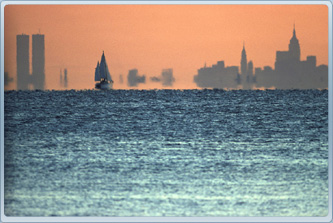
Another film image in the Scapes gallery has gone even larger. “The Way We Were” was used as a background for Malcolm Forbes Toy Boat exhibit while I was at the National Geographic, and the final print size was 10 feet by 50 feet! The sailboat in the photograph was almost 5 feet high in the final print. 8 x 10 in. Internegs, 7 of them, were made lengthwise from the original (35mm Kodachrome 64), and the final print panelized and seamed. To my knowledge, it is still the longest print made at the Geographic from a single 35mm original.
More to come. Check back.
|
|
 |
The Way We Were |
Links | Photography Resouces
Education | Professional
The DAM Book - How to think about your Digital Assets (files) and their Management. This book, now in its 2nd edition, continues to be my bible– it'll be yours, too.
DAM Useful - Great, time-saving scripts for Photoshop CS2/CS3/CS4/CS5/CS6/CC for use by your DAM software (e.g., iView, Expression Media), and much more.
CMYK 2.0 - Finally! The definitive explanation of how you get your images translated from your monitor to ink on paper, and much more.
Lynda.com - Extraordinary online learning library for use anytime, anywhere. For your questions at midnight, and all other hours, too.
NAPP - National
Association of Photoshop Professionals.
One Look Dictionary -
The best dictionary/ies on the web.
ASMP - American Society
of Media Photographers.
Washington DC Chapter
- My chapter of the above.
APA - Advertising
Photographers of America.
Weather | Astronomy | Maps
US Weather - Lots of data, quickly, including twilight, sunrise and sunset times, even if stuck on a slow dial-up. Just enter the Zip and go.
Accuweather - I recommend the paid site for the 15-day forecast tools, the ability to look hour by hour, and tons more.
Visual
Satellite Imagery - Great visual satellite imagery.
Aviation
Digital Data service - Great visual satellite imagery as well, alternate site to the above.
SunPath - THE best program for all sun location planning information! Great printout.
Helios - Great iPhone app for location sun work, particularly with the advent of the map feature in v3.
Focalware - Another great iPhone app for locating the sun AND the moon.
Topozone - Incredibly useful topographic maps of the entire US.
Camera Gear | Misc. stuff you use all the time
Really Right Stuff - The best tripod heads and plates (particularly the L-plates), panorama and specialty gear.
Wimberly Tripod Heads
- Gimbal-type tripod head for long lenses and lots more.
Singh-Ray Filters -
Filters of all kinds, including custom.
Suunto Watches and Compasses - The best you can use and wear.
Little Giant Ladders - The best, strongest, safest, most flexible ladder anywhere, with the most useful accessories.
Printing Supplies
Shipping Tubes - Tubes
for shipping large printso
Computer | Digital
Mac Business Solutions
- All things Macintosh.
Other World Computing
- Memory, pocket drives, specialty cards for the Mac.
My Digital Discount
- Flash memory and more.
X-Rite - Great profiling hardware and software (for monitor, scanner, printer, paper AND projector).
Lots more to come. Check back.
|


